The Illusion of Competence: Why Passive Studying and Generic Timers Fail
Every exam season, millions of students spend hundreds of hours re-reading textbooks, highlighting lecture slides, and re-writing neat summaries. Cognitive science has consistently proven that these passive techniques produce an 'Illusion of Competence', a subjective feeling of mastery because the text looks familiar, followed by devastating mental blankness during the actual examination.
To achieve durable, high-order retention, learning must incorporate Active Recall and Spaced Retrieval. You must force the brain to actively extract information from memory under time constraints. However, applying a generic stopwatch across a full day of study leads to severe subject imbalance: students naturally spend 80% of their energy on topics they already enjoy, while neglecting the difficult subjects where grades are won or lost.
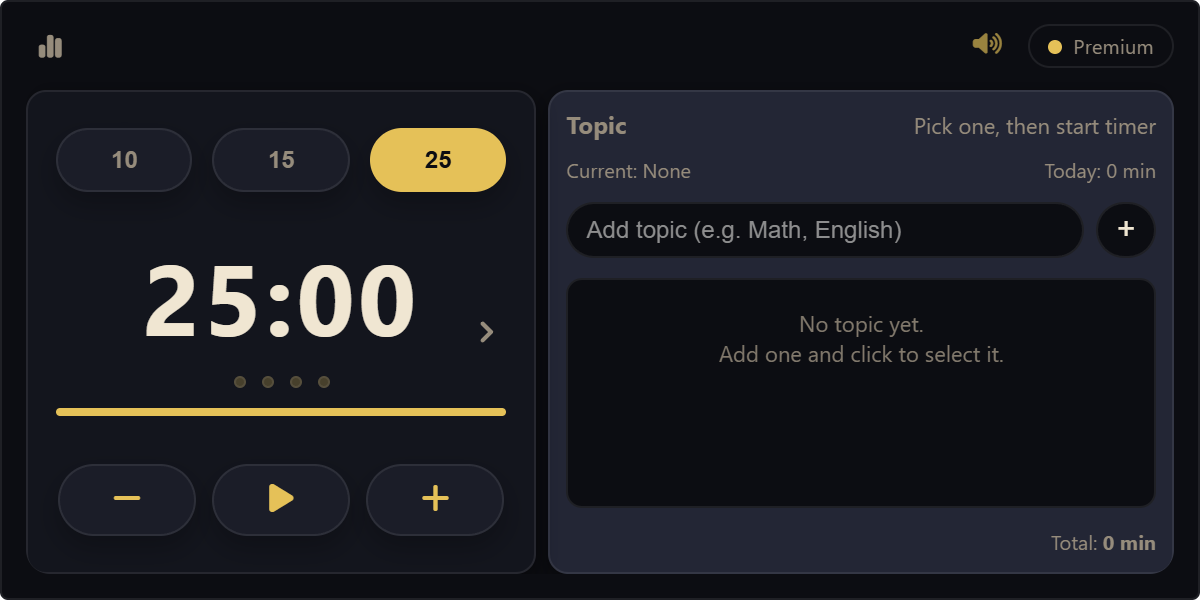
The Study Time Tracker widget is engineered specifically for academic revision. It combines precision Pomodoro time-boxing with multi-subject categorization, allowing you to log focused study blocks tagged by course (e.g., Biology, Organic Chemistry, Civil Procedure, European History) directly inside your Notion study workspace.
The Power of Interleaved Practice: Rotating Topics for Neural Retention
In groundbreaking research on learning efficiency, cognitive psychologist Dr. Robert Bjork formulated the concept of 'Desirable Difficulties.' Among the most powerful of these is Interleaving: the practice of alternating between distinct topics or problem types during a single study session rather than engaging in massed 'blocked' practice (studying one subject for eight hours straight).
When you practice blocked revision, your brain enters an automated pattern-matching mode where each problem resembles the last. In contrast, when you rotate subjects across 25-minute Pomodoro sprints, your brain is forced to continually discriminate between conceptual frameworks, dramatically strengthening long-term synaptic consolidation.
The Study Time Tracker makes interleaving seamless. Switch from Quantitative Mathematics to History Analysis with a single tap, track cumulative hours invested across each discipline, and eliminate academic blind spots before exam day arrives.
4 Academic Revision Frameworks for Notion
The 3-Subject Interleaving Rotation
Structure your daily study sessions in triplets: 25 minutes on a quantitative problem-solving subject, followed by 25 minutes on a conceptual reading subject, followed by 25 minutes on language or flashcard recall. The contrast keeps your prefrontal cortex fresh and prevents cognitive fatigue.
The Feynman Technique Sprint
Dedicate an entire 25-minute Pomodoro sprint to explaining a complex concept in plain, simple language on a blank Notion page without consulting your notes. When you encounter a gap or struggle to explain a point clearly, spend the remaining minutes reviewing your source material to fill the deficit.
Spaced Retrieval Integration
Pair your Study Pomodoro with a Notion Spaced Repetition database. Dedicate your first morning Pomodoro exclusively to reviewing material learned 3 days, 7 days, and 21 days prior before moving on to new lecture content.
The Pre-Exam Taper Protocol
Two weeks prior to major exams, transition your Pomodoro sprints from passive note review to timed past-paper questions. Simulate real exam conditions: no notes, strictly timed 25 or 50-minute blocks, followed by rigorous error analysis during the subsequent session.
Architectural Breakdown: Study Pomodoro vs. Generic Notion Timers
Why dedicated academic study trackers deliver superior revision outcomes compared to basic timers:
Database Tables & Records
Best for deep historical storage, relations, and structured records