The Psychology of Circular Time: Breaking Free from the Linear Grid
For millennia before the advent of mechanical clocks, humanity perceived time as cyclical: the daily arc of the sun, the phases of the moon, and the annual cycle of the seasons.
Modern linear calendar grids flatten this circular reality into rigid rows of boxes, making it difficult to perceive where you actually stand within the month's overall cycle.
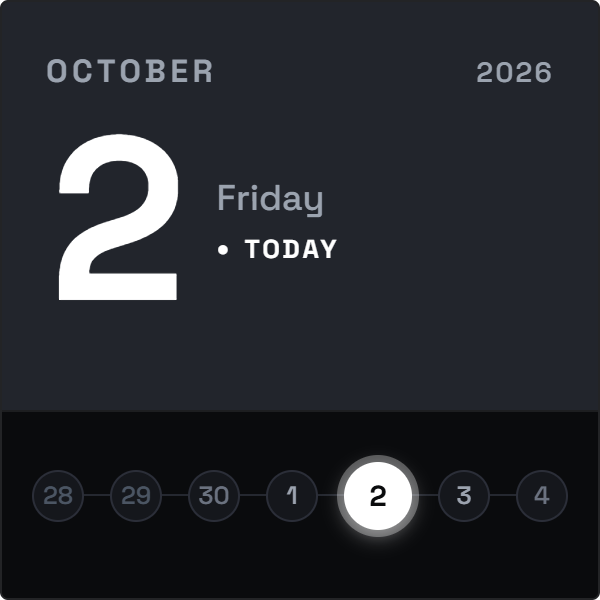
The Arc Radial Calendar reimagines date tracking through circular geometry: dynamic radial arcs that sweep across the month, rendering elapsed time versus remaining runway with immediate clarity.
Radial Information Architecture: The Science of High-Density Geometry
Circular meters allow the human brain to evaluate percentage progress and remaining capacity significantly faster than reading numeric dates in tables.
Central date numbers are surrounded by concentric progress arcs that glow as the month matures, creating an intuitive visual runway.
The minimalist radial design looks stunning in developer command centers, sci-fi creative spaces, and modern aesthetic Notion setups.
4 Radial Planning Strategies for Notion
The Monthly Runway Gauge
Use the radial arc as your primary gauge for monthly progress. When the arc crosses 75%, prioritize closing active deliverables.
The Developer Mission Control
Pair the Arc Radial Calendar with dark neon themes and monospace code databases for a futuristic terminal setup.
Runway Deficit Detection
Compare your project completion percentage against the calendar's radial arc to spot output deficits before month-end.
The Minimalist Geometric Centerpiece
Position the circular arc at the visual center of your dashboard as an elegant, non-intrusive geometric anchor.
Architectural Breakdown: Arc Radial Calendar vs. Flat Linear Grids
Why radial geometric time tracking provides faster temporal orientation than flat calendar tables:
Database Tables & Records
Best for deep historical storage, relations, and structured records