Why Line-Item Budgets Fail: The Power of Proportional Buckets
Traditional budgeting advice tells individuals to track every coffee, grocery receipt, and restaurant dinner across fifty separate spreadsheet categories. Studies show 80% of people abandon this high-friction approach within four weeks.
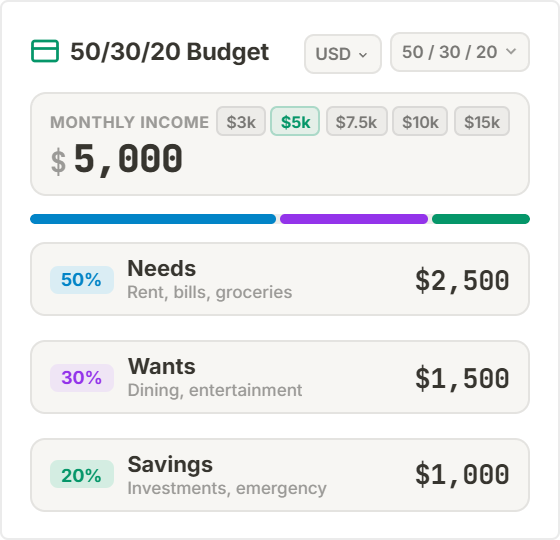
Popularized by Harvard bankruptcy expert and Senator Elizabeth Warren, the 50/30/20 rule replaces tedious micromanagement with three broad, intuitive allocation buckets: 50% for Essential Needs (housing, utilities, groceries, debt minimums), 30% for Lifestyle Wants (dining out, entertainment, hobbies), and 20% for Wealth Creation (emergency funds, index funds, aggressive debt payoff).
As your income fluctuates or expands, the proportional buckets scale automatically, preserving financial balance without recalculating complex spreadsheets.
Adaptive Ratios: Tuning Buckets for Your Life Stage
While 50/30/20 is a proven baseline, real-world living costs vary: in high-cost-of-living metropolitan cities, housing alone may consume 40% of take-home pay.
Our widget includes 1-tap preset variations: the High-Rent 60/20/20 model for urban dwellers, and the Aggressive FIRE 40/20/40 model for young professionals sprinting toward early financial independence.
The fluid three-segment allocation bar gives you immediate spatial feedback on where your cash flow is deployed.
4 Proportional Budgeting Frameworks for Notion
The Paycheck Direct-Deposit Split
Configure automated bank transfers on payday (20% straight to investment accounts) so savings happen before discretionary spending.
The Lifestyle Inflation Cap
When receiving a salary raise, allocate 50% of the increase directly to the 20% savings bucket to prevent lifestyle creep.
The Guilt-Free Spending Envelope
Treat the 30% Wants bucket as completely guilt-free discretionary income once Needs and Savings obligations are satisfied.
The Career Raise Simulator
Scrub the income slider to visualize how upcoming salary negotiations or freelancing retainers expand your dollar allocations.
Architectural Breakdown: 50/30/20 Budget Widget vs. Complex Spreadsheet Trackers
Why proportional allocation buckets outperform rigid line-item spreadsheets:
Database Tables & Records
Best for deep historical storage, relations, and structured records